
Views: 0 Author: Site Editor Publish Time: 2026-01-07 Origin: Site


In today’s digital era, businesses are increasingly turning to advanced display technologies to improve collaboration, engagement, and productivity. The choice between an interactive projector and an interactive flat panel is a common dilemma for many companies looking to enhance their meetings and presentations. Both display options offer unique features and benefits, but understanding which one is best suited to your needs can be a challenge. This article will compare interactive projectors and interactive flat panels, highlighting key differences in interaction, display quality, installation, cost, and suitability for various use cases. By the end, you’ll have a clearer understanding of which technology is the best fit for your business.
For businesses looking to enhance their meeting spaces or collaboration environments, choosing between an interactive projector and an interactive flat panel is often not a simple decision. Both technologies have become increasingly popular in conference rooms, classrooms, and exhibition spaces. However, they offer different advantages depending on the environment and intended use.
An interactive projector transforms any flat surface into a touch-enabled interface, offering flexibility in terms of screen size and placement. Meanwhile, an interactive flat panel is a standalone screen with built-in touch capabilities, typically providing a more stable and consistent display.
So, which one should you choose for your business? Let’s dive into the details to help you make an informed decision.
When it comes to interaction and display quality, both the interactive projector and the interactive flat panel have their strengths, but there are significant differences between them.
Sensory Feedback & Image Quality: Interactive flat panels generally offer better image quality and tactile feedback. Since these panels are designed as touch screens, they provide a seamless and responsive experience. The visuals are sharp, with bright, high-definition images that are perfect for both presentations and interactive applications.
In contrast, interactive projectors use external surfaces (walls, whiteboards, or tables) for projection, and the image quality can vary depending on the quality of the surface, ambient lighting, and distance from the projector. While modern projectors offer impressive resolutions and image clarity, they may not be able to match the crispness of flat panels in environments with high ambient light.
However, interactive projectors can offer a larger projection size, making them ideal for large rooms or spaces where you need to display content on a bigger scale. The flexibility to project onto any flat surface, like a wall or table, allows for more dynamic and versatile applications.
The installation process and space requirements are crucial factors when deciding between an interactive projector and an interactive flat panel.
Room Size & Mounting Flexibility: Interactive flat panels are standalone units that need to be mounted on a wall or placed on a stand. This makes them a great option for smaller to medium-sized spaces where space is limited and where a fixed, stable display is preferred. However, these panels have fixed screen sizes and may not be as versatile in larger rooms.
On the other hand, interactive projectors offer greater flexibility in terms of installation and space utilization. These projectors can be placed at various distances from the surface and still produce a large screen size. They can be used in spaces where wall-mounted screens might not fit or where the ability to scale the projection size is needed.
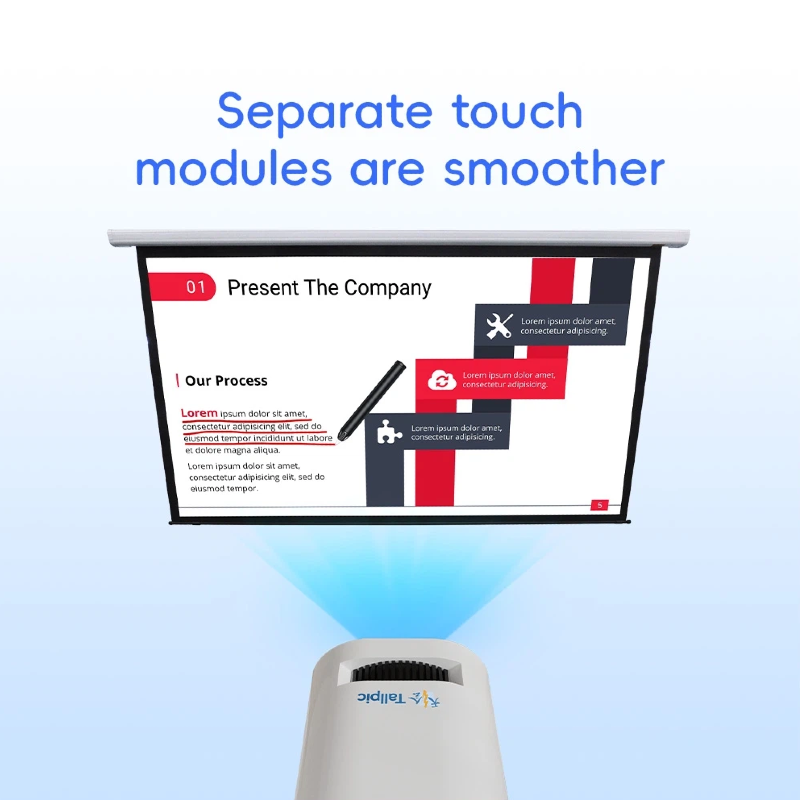
Ultra-Short Throw Projectors: Many modern interactive projectors, such as the Tallpic ultra-short throw projector, are designed for smaller spaces and can project large, clear images from just a few inches away from the wall. This flexibility makes projectors a great choice for spaces with limited wall space, like small conference rooms or classrooms.
The cost of adopting interactive display technology is a major factor in the decision-making process. While both interactive projectors and interactive flat panels come with their own price points, the cost comparison can vary based on the initial investment and ongoing maintenance.
Initial vs Maintenance Costs: Interactive flat panels often have a higher upfront cost due to the integrated touchscreen functionality and built-in features. However, they typically require less maintenance in the long run since they have fewer moving parts and do not rely on external projection surfaces.
In comparison, interactive projectors generally have a lower initial purchase price, especially for basic models. However, over time, additional costs may arise, such as the need for projector lamps (which have a limited lifespan), calibration, and maintenance. Projectors also require a suitable surface for projection, which may involve additional setup costs, such as installing special screens or enhancing ambient lighting.
While interactive projectors offer a more cost-effective initial investment, they may not always be the best long-term solution for every business.
Both interactive projectors and interactive flat panels are versatile tools, but certain scenarios favor one over the other. Understanding the unique strengths of each technology will help you choose the right solution for your business.
Which Scenarios Favor Projectors: Interactive projectors are ideal for larger rooms and spaces that require a flexible display solution. They are perfect for classrooms, conference rooms, or exhibition halls where a large projection size is needed but wall-mounted screens are impractical. Projectors are also great for businesses that need to project content on irregular surfaces or in places where mounting a flat panel would be challenging.
Which Scenarios Favor Flat Panels: Interactive flat panels are well-suited for smaller, fixed spaces, such as meeting rooms, boardrooms, and classrooms where a stable, high-quality display is required. These panels are perfect for environments that prioritize image quality, reliability, and a seamless interactive experience. They are also the preferred choice for environments where space is limited and ease of setup is essential.
One of the standout features of interactive projectors is their ability to cover large areas. Unlike interactive flat panels, which are limited by their physical screen size, interactive projectors offer flexibility in scaling up or down based on the needs of the space.
Screen Scaling & Flexibility: Interactive projectors can produce a much larger display than a flat panel, making them ideal for large meeting rooms, lecture halls, or exhibition spaces. For example, an interactive projector can project a screen size ranging from 40 inches to over 100 inches, depending on the distance and room size. This scalability allows businesses to customize their display setup for specific applications.
Multi-User Interaction: Many interactive projectors support multi-touch functionality, enabling several users to interact with the projected content at the same time. This feature is perfect for brainstorming sessions, collaborative work, or interactive presentations in larger settings, where multiple people need to interact with the content simultaneously.
When deciding between an interactive projector and an interactive flat panel, the key is to evaluate your specific needs, space constraints, and budget. If your business requires flexibility, large-scale displays, or a more affordable initial investment, an interactive projector is an excellent choice. It provides dynamic, interactive experiences that are ideal for larger spaces and versatile environments.
On the other hand, if you need a high-quality, stable, and easy-to-maintain solution for smaller spaces with fixed installation needs, an interactive flat panel may be the better fit. It offers superior image quality and is more suitable for environments where consistent performance and high-definition content are critical.
At Tallpic, we specialize in developing cutting-edge interactive projectors that provide superior flexibility, reliability, and ease of use for businesses and educational institutions. If you’re looking to elevate your meeting, classroom, or exhibition experience, contact us today to discover how our interactive projectors can meet your needs.
What is the primary difference between an interactive projector and an interactive flat panel?
Interactive projectors offer flexible, large-scale projections on any surface, while interactive flat panels are standalone, touch-enabled displays with higher image quality and stability.
Are interactive projectors suitable for small rooms?
Yes, with ultra-short throw projectors, interactive projectors can be used in small spaces, providing large images even from a short distance.
Which technology is more cost-effective?
Interactive projectors typically have a lower initial cost, but flat panels may be more cost-effective in the long term due to lower maintenance needs.
Can I use interactive projectors for remote meetings?
Yes, interactive projectors can be connected wirelessly to laptops and other devices, making them ideal for hybrid meetings with remote participants.


